 O`Z
O`Z
 РУ
РУ
 EN
EN
 العربية
Erasmus+
Erasmus+ KA171 Staff Mobility Program at the University of Bucharest
Internship of the Academy’s Faculty Members at the University of Bucharest Concluded
As part of the Erasmus+ KA171 Staff Mobility Program at the University of Bucharest, participants had the opportunity to comprehensively explore the university’s academic and educational environment, library and resource centers, the educational and methodological activities of the Faculty of Philosophy, as well as its scientific publishing system.
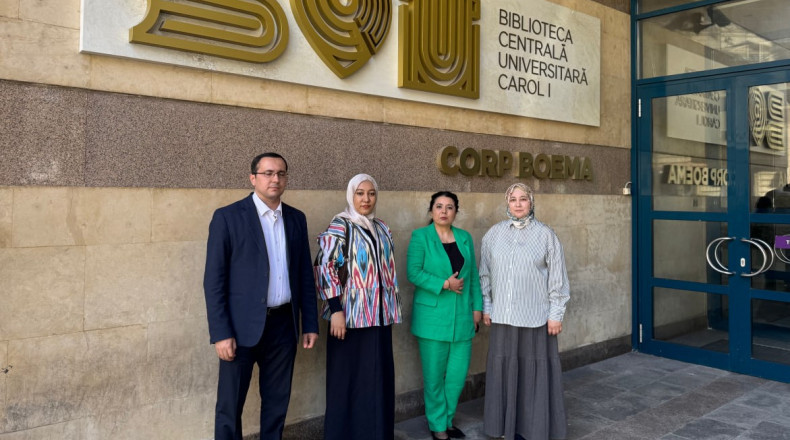
During the internship, Mr. Odiljon Ernazarov, Head of the UNESCO Chair “Religious Studies and Comparative Study of World Religions” at the International Islamic Academy of Uzbekistan, Associate Professors Dilafruz Turdiyeva and Mohira Abdullayeva from the same department, and Associate Professor Nilufar To‘ychiyeva from the ICESCO Chair “Islamic Studies and the Study of Islamic Civilization” closely familiarized themselves with the activities of the Faculty of Philosophy Library of the University of Bucharest and the Central University Library “Carol I”.
The “Carol I” Central University Library is one of Romania’s major academic centers, comprising a central building, a pedagogy division, and 16 branch libraries affiliated with the university. Its collection includes more than 2.4 million volumes and supports teaching and research in fields such as literature, psychology, philosophy, law, history, geography, economics, and mathematics.
Today, the library administration places special emphasis on preserving rare collections and expanding digital resources. The RESTITUTIO digital platform of the “Carol I” Library contains digitized collections of manuscripts, old and rare books, newspapers, serial publications, iconographic and cartographic materials, as well as audio-visual resources. These materials play a significant role in academic research, source studies, cultural heritage preservation, and scholarly exchange.
Founded in 1860, the Faculty of Philosophy is one of the oldest faculties of the University of Bucharest. Its structure includes the Department of Theoretical Philosophy, the Department of Practical Philosophy and History of Philosophy, and the UNESCO Chair on Intercultural Exchanges, Good Governance, and Sustainable Development.
During the internship, the participants examined the faculty’s educational programs, curricula, and course syllabi. The Bachelor’s Program in Philosophy lasts three years and consists of 180 credits. The program is built upon fundamental disciplines such as Logic, Ontology, Theory of Knowledge, Ethics, Aesthetics, History of Ideas, and Philosophy of Language. In the third year, students may choose among specialization modules in Theoretical Philosophy, Political and Moral Philosophy, History of Philosophy, or Philosophy of Culture.
At the master’s level, the faculty offers a range of programs taught in Romanian and English. These include Applied Ethics, History and Circulation of Philosophical Ideas, International Development Studies and Ethics of International Relations, Philosophy and Critical Thinking, Philosophical Counseling, History of Art and Philosophy of Culture, as well as English-language programs such as Communication and Intercultural Studies, Intercultural Management, and Business Administration.
The faculty’s scientific publishing activities were also thoroughly examined during the internship. The Faculty of Philosophy publishes several academic journals, including Annals of the University of Bucharest. Philosophy Series, Public Reason, Romanian Journal of Analytic Philosophy, and International Journal of Aesthetics and Philosophy of Culture. These journals are open access and indexed in international academic databases, making them widely recognized among scholars. Notably, Public Reason has been indexed in the Scopus database for many years.
In addition, the internship provided an opportunity to study the University of Bucharest’s role in international academic integration, particularly its participation in CIVIS – Europe’s Civic University Alliance. Established under the European Commission’s European Universities Initiative, CIVIS currently brings together 11 leading European universities. Alongside the University of Bucharest, the alliance includes Aix-Marseille University, the National and Kapodistrian University of Athens, Université libre de Bruxelles, Universidad Autónoma de Madrid, Sapienza University of Rome, Stockholm University, Eberhard Karls University of Tübingen, the University of Lausanne, Paris Lodron University of Salzburg, and the University of Glasgow.
The CIVIS Alliance serves as an important strategic platform for enhancing the University of Bucharest’s competitiveness in international education and research. One of the alliance’s distinctive features is its foundation on the concept of the “civic university,” which views universities not only as centers of education and research but also as institutions that promote social development, intercultural dialogue, environmental sustainability, and civic responsibility. Consequently, CIVIS activities encompass educational and research initiatives addressing global challenges such as healthcare, climate change, digital transformation, urbanization, migration, and European cultural heritage.
Overall, the internship conducted at the University of Bucharest under the Erasmus+ KA171 Staff Mobility Program provided valuable insights into contemporary trends in European higher education, the activities of international university alliances, scientific publishing policies, the management of libraries and digital resources, and the development of academic programs in accordance with international standards. The experience gained will contribute to strengthening international cooperation, implementing joint research projects, publishing scholarly articles in journals indexed in Scopus and Web of Science, and further modernizing the educational process.

Editors’ Picks

New comment